If a project with city backing, a fishing club's cash, and a dedicated planning staff took fourteen years to get a dock permitted, how long do you think your bulkhead repair will take?
That is not a rhetorical trick. It is the exact math playing out right now at Ancich Waterfront Park, where the City of Gig Harbor has been trying to build a commercial fishing homeport since it bought the site in 2012. If you own, or hope to buy, waterfront property in Gig Harbor, this project is the clearest local proof of something most listing checklists gloss over: the real constraint on shoreline work isn't money or good intentions. It's a calendar that nobody controls.
The Dock That Took Fourteen Years
The Commercial Fishing Homeport has never lacked support. The Gig Harbor Commercial Fishermen's Club contributed $200,000 toward it. The city funded the rest partly through Real Estate Excise Tax revenue and a $150,000 commitment from the Port of Tacoma's Local Economic Development Investment Fund. The plan itself is modest by industrial standards: a 280-foot main walk float, fifteen 60-foot finger floats, and a gangway to give commercial vessels a real home base, replacing the aging, creosote-laden Jerkovich Pier.
None of that made the permitting move faster. The city filed its first Joint Aquatic Resources Permit Application in 2022. The Army Corps of Engineers did not meaningfully engage until October 2023. What followed was a slow negotiation over mitigation, the environmental trade the city had to offer for adding new overwater coverage. The city proposed planting three acres of kelp, Saccharina and Gracilaria, across two sites including the txʷaalqəł Estuary, and needed to account for 503 Conservation Credits to offset the impact. By 2025, federal agencies had concluded the kelp-planting strategy would not work under current science. A well-funded, well-supported public project had to go back and rework its environmental math twice.
The city's Notice of Decision, issued this year, finally cleared the Shoreline Substantial Development Permit, along with a Major Site Plan Review and a SEPA Determination of Nonsignificance dated April 27, 2026. Even with that decision in hand, construction was tied to the next available "fish window," the narrow stretch of the calendar when in-water work does the least harm to migrating and spawning species. The city had projected a July 2026 start, more than a decade after buying the land.
If you are selling or buying waterfront property in Gig Harbor, the lesson is not that permits are hard. It's that the hardest part isn't the paperwork. It's a biological schedule that doesn't care about your closing date.
What "Normal Protective" Actually Covers
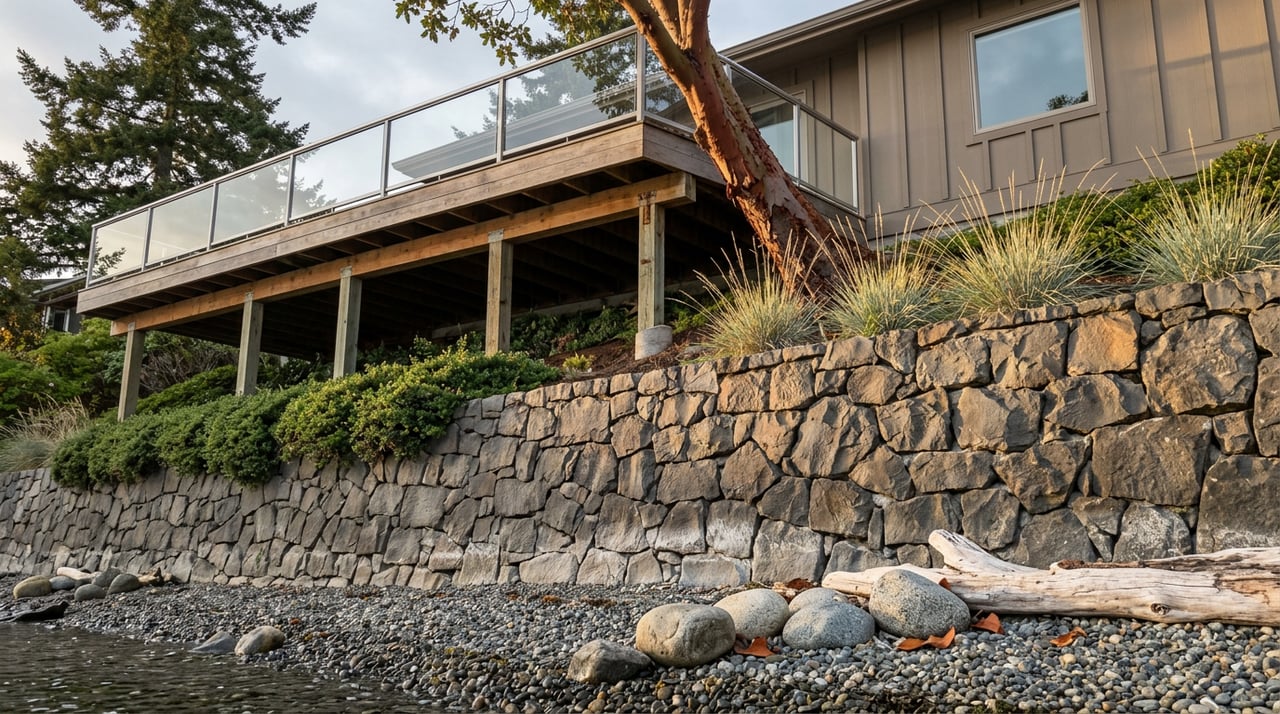
Most Gig Harbor waterfront homes already have a bulkhead, and most sellers assume that means the shoreline question is settled. Pierce County's code treats a "normal protective bulkhead" as exempt from the full Substantial Development Permit process, but only under narrow conditions. The exemption covers structures built at or near the ordinary high water mark for the sole purpose of protecting an existing home from erosion. It does not cover a bulkhead built to create dry land, and it does not survive its own failure quietly.
Here is the part that catches long-term owners off guard: if a bulkhead deteriorates to the point that the ordinary high water mark has effectively moved landward of it, the replacement bulkhead has to go where the water now sits, not where the old one used to stand. A failing bulkhead isn't just a maintenance problem. Left alone long enough, it can shrink the usable footprint of the lot before a single permit application is ever filed.
New or expanded shoreline armoring gets even more scrutiny than a straight repair. County and state policy increasingly favor soft-shore or hybrid stabilization over concrete and steel, which means a homeowner hoping to extend a bulkhead or add one where none existed should expect a longer, more document-heavy process than a like-for-like repair.
The Calendar Nobody Puts on the Listing
A permit delay measured in weeks is an inconvenience. A permit delay measured in fish windows is a different kind of problem entirely.
In-water construction in Pierce County waters is boxed into short seasonal windows meant to protect salmon and other species during their most vulnerable periods. Miss this year's window, for any reason, administrative or otherwise, and the next opportunity isn't next month. It's next year. That single fact is why the Homeport's timeline stretched the way it did, and it applies just as much to a private dock replacement as it does to a 17-boat public marina.
For a seller, this means a dock or bulkhead project started too close to a listing date can leave a buyer facing a full season's wait before any work can legally proceed. For a buyer, it means a home with a "planned" shoreline repair that hasn't cleared permitting yet may come with an unavoidable delay attached, regardless of how motivated the seller is to get it done.
The Homeport's Permit Clock
| Year | What Happened |
|---|---|
| 2012 | City of Gig Harbor purchases the dock area at Ancich Waterfront Park |
| 2022 | First Joint Aquatic Resources Permit Application filed |
| 2023 | Army Corps of Engineers begins substantive review |
| 2024 | City Council fully funds construction; revised mitigation plan submitted |
| 2025 | Third mitigation plan submitted; federal agencies rule out the kelp-planting approach |
| 2026 | Shoreline permit cleared, SEPA Determination of Nonsignificance issued April 27; construction targeted for the next fish window |
A Rulebook Being Rewritten While You Own the House
Pierce County's current Shoreline Master Program dates to 2018, built on a shoreline study completed back in 2009. That is changing. The county has launched its 2029 Shoreline Master Program Periodic Review, with public comment periods and hearings scheduled through 2026, and a specific focus on sea level rise and shoreline access. Nothing about an existing, legally built structure disappears the moment the update takes effect, but the standards a future repair or replacement gets measured against are actively being redrawn right now.
For an owner planning to sell in the next few years, that matters more than it sounds like it should. A bulkhead or dock that qualifies as legal nonconforming today under the current program isn't guaranteed the same treatment under the next one, particularly as the county incorporates new sea level rise mapping into its shoreline planning.
If You're Selling: Build the Packet Before You Need It
The single most useful thing a waterfront seller can do is stop treating permits as a closing-week task. Pull together, ideally 60 to 90 days before listing, a survey identifying the ordinary high water mark and lot boundaries, any existing shoreline permits or a written exemption letter if the work qualified as exempt, dock and bulkhead inspection records from a marine contractor, and septic or well documentation if the property isn't on municipal service. A buyer's lender and their own due diligence will ask for all of it eventually. Having it ready before the first showing signals a property without hidden shoreline risk, which is exactly the kind of listing that moves through escrow without a mid-transaction surprise.
If You're Buying: Ask Before You Waive the Contingency
For an investor or land buyer eyeing Gig Harbor waterfront with plans to repair, replace, or add shoreline structures, the Homeport timeline is a useful gut check on expectations. Before waiving a contingency, ask whether any existing dock or bulkhead has documented permits or exempt status, whether the shoreline has visibly moved relative to the structure, and whether any planned work would fall inside or outside this year's in-water construction window. None of those questions require a lawyer to ask. They just require knowing that the calendar, not the county office, sets the real pace.
A Few Straight Answers
Does a small dock repair really face the same review as a project like the Homeport? No. Small, in-kind repairs that don't change footprint or value often qualify for exemption. But any increase in size, value, or waterward extension moves a project into full review, and the same seasonal fish windows apply no matter how modest the scope.
What if my bulkhead already has an old permit? An older permit may support legal nonconforming status, but repair or replacement is treated as a new decision, not an automatic renewal, especially if the shoreline has shifted since it was built.
Should I just wait for the 2029 update before doing any shoreline work? Waiting doesn't pause the rules already in effect, and it doesn't slow a failing structure down. A bulkhead that keeps deteriorating while you wait only risks a smaller rebuilt footprint later.
Shoreline property in Gig Harbor rewards patience and good documentation in equal measure. If you're weighing a sale, a purchase, or a repair project on the water and want a clear-eyed read on timing before you commit to a date, Julia Runyan has spent decades in this market and is glad to talk through what your specific property is facing. Let's Connect.